Robert Browning Biographical Detail and Influences that Provoked Him to Write ‘My Last Duchess’
‘His poetic genius is most evident in his mastery of the dramatic monologue as a technique for powerful poetic narrative and rich psychological portraiture’. *
William Browning was born in 1812 in Southeast London. His father worked as a clerk in the Bank of England, encouraging his son to explore the vast collection of books he owned. This meant Browning’s reading was not confined to a particular subject or narrative but varied and textured with books that included works on history and education. These greatly impacted Browning’s writing, contributing significantly towards a reputation he would later acquire for a vast knowledge of a vast number of subjects. One author that influenced him in particular was Percy Bysshe Shelley, an influence that dictated many lifestyle choices and philosophies he held at the time such as his atheism and vegetarianism. Furthermore, Browning’s love for Shelley would develop into a passion for other great Romantic poets such as Keats and Byron that would go onto impact his work and life. Because of Browning’s family’s tremendous wealth he was able to acknowledge poetry as his love and profession whilst not being contingent on it for money. Surprisingly, his formal education was not extensive but still present. His father was educated in both Greek and Latin, passing on what he knew to his son.

*photograph of Robert Browning
Browning’s mother, Sarah Anna Wiedemann born in Scotland by German parents was a keen churchgoer, ensuring that her son was properly educated in religious practices. Browning was a non-conformist though and was excluded from many Older English Universities because of this. He had a very brief stint at London University and apart from a few short trips abroad spent most of this period living in London with his parents. It was over this time that he published his early plays and lengthier poems. Pauline: A Fragment of a Confession, Browning’s first work is full of personal anxieties and passions he had whilst growing up. He was greatly affected by some of the criticisms aimed at him over this one, with John Stuart Mill condemning the dramatic monologue’s “intense and morbid self-consciousness” and his exposure and exploitation of emotions and feelings he was having at the time. This hurt Browning deeply, which cemented his decision never to publish anything with such vulnerable confessions of his inner self, vowing to follow strict objectivity henceforth. He was adamant, when in discussion in later years that his novels should be seen as impersonal, and that any expression present was of an imaginary character’s not his own.
Paracelsus was published in 1835 and Sordello in 1840, with the latter coming under harsher critical response. However, by this time he was recognised as one of the leading poets of the day. Many other works were published around this time including several short poems, among the most famous being ‘My Last Duchess’. Now, I shall refrain from talking further about Robert Browning’s life to focus on the topic at hand. More specifically, what provoked Browing to write a poem of such intense feeling and profundity in My Last Duchess. In 1844 Elizabeth Barrett published ‘Poems’, a work that included praise for Browning’s work. Shortly after, he contacted her to express his gratitude. Soon they had met and had fallen in love. Elizabeth Barrett had for a long time been an invalid, room bound with no known cure for her illness. Her father was an appalling, vile man, jealous of his daughter which motivated his treatment of her. Treatment that included refusing her access to essential medical treatment. Browning had been regularly corresponding with Ms. Barrett and felt compelled to act. They married secretly and departed for Pisa.
What is most interesting here is the poem’s imposing similarities to events that transpired in Browning’s personal life (1845) *. This story would appear to be the obvious inspiration for My Last Duchess because it is about a man who is jealous and paranoid that his wife will leave him for another, driving his impetuous and unfair treatment of her. The reader is left unsure whether he was eventually driven to commit parricide. This is a clear reflection of Elizabeth’s father’s treatment of her and the lengths to which he was prepared to go to isolate her from the world.
However, these events occurred three years after the publication of My Last Duchess (1842) *. One likely possibility is that he was involved with Ms. Barrett earlier than is suspected and that they maintained a high standard of discretion in their correspondence and relationship. Because it seems to me that the story and characters within the poem share qualities that are so strikingly similar to those of Ms. Barrett’s domestic situation controlled by her father that it would be wholly improbable and perhaps impossible for them not to be linked. Furthermore, the vividness and intensity of feeling with which Browning portrays The Duke of Ferrara (Edward Barrett) is so powerful that one wonders whether such a portrayal would have been possible without the artistic borrowing from the situation that Robert Browning and his love found themselves in. For as we know, writers (in particular writers who strive to find deeper meaning) frequently refer to people from their pasts and presents. More evidence for the difficult relationship with Edward Barrett and the strength of their passion for each other was the couple’s decision to marry in secret in 1846 after just a year.
*From Encyclopaedia Brittanica 1974 Edition
How Power and Conflict Is Represented in London Compared to The Charge of the Light Brigade
The Charge of the Light Brigade by Alfred Lord Tennyson is a poem that represents the power of rank and how soldiers must obey the commands of uncaring and ignorant superiors despite the knowledge of inevitable death. It portrays the role of the soldier as to not be conflicted, to not waver regardless of feelings they may have that what they are being ordered to do is wrong or failing to foresee their own survival. Not “to make reply…. not to reason why”. Instead, to obey and ride into the “valley of death”.
London by William Blake is “a critique of human power, exposing the separation between those in power and those who are suffering. The suffering is inescapable because it is brought about by those in control”1. It represents human control and man’s efforts to own and dominate both nature and other men. And how our ideas and philosophies have led to our own philosophical and material imprisonment. In other words, we have taken the freedom we once had away from ourselves.

*’Guernica’ by Pablo Picasso
When seeking to draw comparisons between these two poems it is important to look for themes that are significant in both works. One such example of this is bloodshed and the soldier’s ‘meaningless’ death. This is a theme far more evident in Tennyson’s poem but is by no means absent in Blake’s. And can be heard distinctly in the third stanza with ‘the hapless soldier’s sigh runs in blood down palace walls’. Both poems were written with war and conflict on the consciousness of both Blake and Tennyson. Blake was a strong supporter of the French Revolution, conveying a point very similar to that of Tennyson’s, that the soldier feels and is (despite all of the blood spilt) unable to change things. Because of this their death is in vain, and while the cause maybe honourable the toll is not.. The Charge of the Light Brigade is about this in its entirety, whereas London (still holds this as an important and relevant thing) aims to make a point of equal profundity and impact. The issue painfully relevant to London at the time; namely, the disease and squalor of impoverished communities provoked by an upper, wealthy class unwilling to assist in an affair of their own design. London is full of vivid descriptions and observations made by a politically aware and charged Blake, attempting to make clear the destitution of those at the heart of Britain’s industrial revolution.
Also shared between the two poems is the notion of a concept that should be filled with happiness, glory and celebration but is not because of a state that should and could be changed. In TCOTLB it is the soldier’s imminent death because of no value for their life on the part of superiors and their poor decision making. War of course, is an effort that involves the loss of life and should not be considered a necessary thing, but that is not what is relevant here. What Tennyson wishes to convey is a feeling of sorrow and regret for the demise of so many despite opportunities to prevent it. And how if we had more regard for the lives of others, if we really wished for their survival a way would be found to save them. And that the only way we can justify so much preventable death is to glorify it, to glorify and honour their actions. Similarly, in the final stanza of ‘London’ Blake employs the reader to contemplate whether ‘sacred’ events such as marriage should be plagued by depravity or whether they should be fuelled by happiness.
In summary, both poems for me express the need for change and reform, the necessity for those in control to value and strive to protect their fellow beings, to show humanity. They convey the message that there comes a time when we need to overrule our seemingly obvious and natural impulses to do ‘right’ by those failing in a cruel world.
1*Taken from William Blake: ‘London’ – Mr Bruff Analysis
22/10/24
Analysis of ‘War Photographer’ by Carol Ann Duffy
War Photographer is a poem that conveys in a subtle yet striking way the experiences that those tasked with documenting the greatest tragedies in human history must endure; and the effects that such experiences have on their mental state and consciousness. Perhaps the poem’s central purpose is to acknowledge the lesser-known mass who, during wartime, are not commended to the extent that soldiers and those who are commonly associated with having to withstand the hardest of war’s forces are. From medics to journalists, and, in this very particular journalistic denomination, war photographers. For, during the time period the poem focuses on, censorship in many forms of written journalism was prevalent, especially in reports detailing the horrors that the civilian masses would rather not hear of. In this sense, photography was present as an uncensored form of capturing the innate peril that faced everything and all within a warzone that could not be censored or paraphrased into more widely digestible and less morally complex information. To begin with, the title in itself embodies all of these things outside of the context of the poem. It is a simple yet interesting title as it explores a profession that is not often discussed; it therefore draws the reader in and hints at discovery. The reader is not told specifically at what point in history the poem is set but when one takes time to examine the context one learns that it was originally published in 1985, 10 years following the end of the Vietnam war and for the time of numerous other conflicts. During this time, photographic and video evidence of the horrors taking place in these places would have been part of the worldwide media coverage. However, those working on visual documentation in the midst of conflict on land and in the air were less common and perhaps more sporadic. Nevertheless, it is clear that our protagonist was one of the individuals constantly at work in an attempt to make known the chaos that was occurring in various locations around the world.
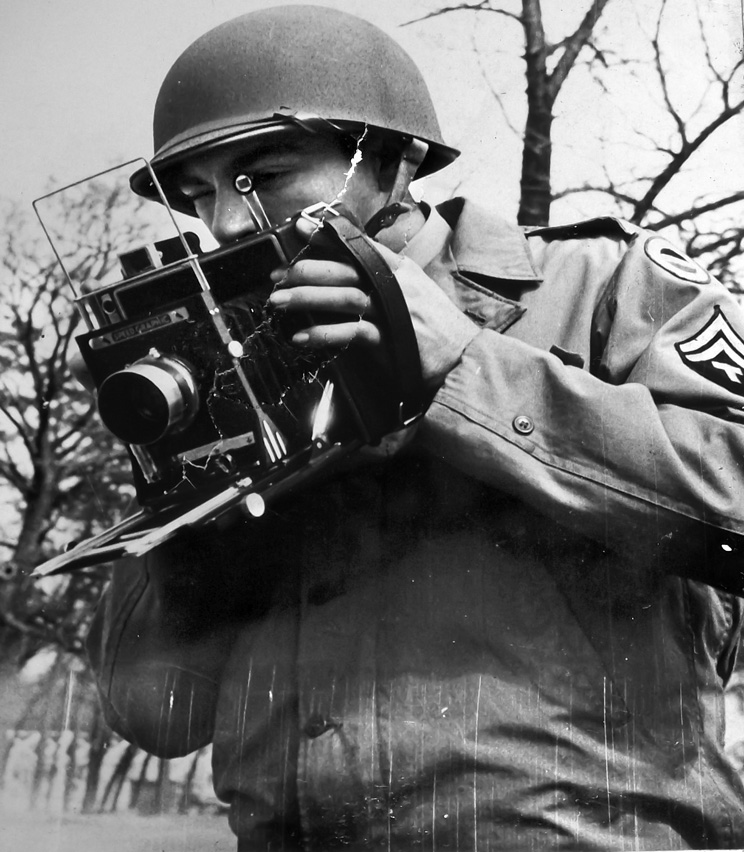
*Corporal Kenneth Elk, a photographer with the U.S. Army’s 163rd Signal Corps Photo Company during WWII
The poem’s first stanza serves to evoke vivid imagery in a fashion that is emotionally poignant and provoking. Here, the poet describes the protagonist as ‘finally alone’ in his dark room where he processes his photographs. She refers to his photographs as ‘spools of suffering’ which are ‘set out in ordered rows’. Note here that the choice to use the word ‘ordered’ contrasts the well organised orientation of the photographs with the disorderly and messy nature of war. Continuing, the writer casts upon the reader an atmosphere of gloom that is brought about by the low red nature of the light that surrounds the protagonist. Use of ‘red’ advocates for blood, ‘softly glows’ suggests low down and altogether dirty behaviour. Next, comparisons are made between the protagonist and a priest ‘preparing to intone a mass’ which rhymes in an extremely fervent fashion with the following line. This next line in particular tells of the many places the protagonist has worked in where his experiences are epitomized by the final moments of the stanza in ‘All flesh is grass’. These vehement and artistically impassioned words symbolise amongst many things the death that those working in such environments see and live amongst. The aforementioned flow is sinuous and pretty, even beautiful; words that are commonly associated with happy and untroubled circumstances. Alas that such a lustrous flow should have to be contrasted with such unhappy manifestations of war.
This opening paragraph introduces the rhyme scheme that is to be used throughout the remainder of the poem. It is not difficult to identify, which makes it prominent and carries great weight for the entire poem. Granted, this is the cast for most poems, yet the use of enjambement within such sturdy stanza structure is potent and especially memorable. Furthermore, what makes the poem even more impressive and stirring is just how rigid and unyielding the form is without losing any of the pathos that comes with the flowing nature and enjambement of the poem. It is clear to me that the author of such a well put together poem as this has mastered their craft. It is because of this poetic mastery that they are able to craft a poem that does not feel the need to over or undercompensate in any element or aspect of its construction. In this sense, one could say that it has achieved as close to an equilibrium as can be accomplished within any piece of poetry. I believe that this, among many other things, is what gives the poem its powerful yet moderated brevity and distinctive stylistic timbre.
In conclusion, War Photographer is a stunning poem whose emotion is thought provoking, an element of the poem that is increased in magnitude by its cogent structured rhyme scheme, which is unwavering and consistent, giving the poem a crescendo effect of feeling and meaning. Moreover, it is a poem that’s relevance is sadly increasing with each day that passes; a powerful reminder and memento that men (to quote the great Aldous Huxley) ‘do not learn very much from the lessons of history’ and that this ‘is the most important of all the lessons that history has to teach’.
Comparison of ‘Bayonet Charge’ and ‘Kamikaze’
‘Kamikaze’ and Bayonet Charge’ are both poems that focus upon presenting true and vehement depictions of the realities of the conflict that both of their protagonist’s experience and feel. In ‘Bayonet Charge’, the protagonist is a soldier, on the battlefield, amidst conflict, overwhelmed, and powerfully aware of the imminent threat to his mortality. It is a poem that uses enjambement to powerful effect, featuring a fluid sequence of events that emanates onto the reader the physical and emotional paralysis a soldier feels when experiencing the effects of sensory overload provoked by sheer terror. We are sucked into a narration of this individual soldier’s vague and distant emotions, blurred by confusion and incertitude, unable to remember the baseless reasons for his present situation, most incomprehensible circumstances. It is evident from the outset of the poem that it is set during a major conflict, and we can infer from the poem’s imagery as well as its historical context that it was set during World War One. It is public knowledge that Hughes’ father served in the war and that the poem was written in an attempt to highlight the barbarity of trench warfare as a tribute to his father’s suffering.
Throughout, Hughes’ employs provocative use of imagery to capture the feeling of in media res that gives the poem much of its visceral emotional potency. Opening the first stanza with the image of the protagonist hot and sweating, tired of supporting the weight of his ‘raw in raw seemed khaki’ and delineating his ‘lugging a rifle numb as a smashed arm’, a chaotic frenzy of shifting weight and spirit, where no terrain seems safe nor sturdy, all is aimless and loose like a fractured pendulum. ‘His foot hung like Statuary in mid stride’ unable to find a solitary resting place. Moving onto the beginning of the third stanza, the soldier is introduced to a ‘yellow hare that rolled like a flame’, a creature in a similar state to our protagonist, frenzied and turbulent, equally as aware of the tumultuous threat to his mortality. Here, Hughes seeks to convey the effect that conflict has on nature; the destruction and dismantling of animal life, habitat, eco system and nature’s equilibrium. For after all, war is but an effort to destroy all equilibriums, natural and unnatural, the very embodiment of mankind’s cynicism and disillusionment. And this is the vehement mode of thought that the poet wishes the reader to take upon whilst reading the poem.
As a title, ‘Bayonet Charge’ is very simple and straightforward. It is as many titles are and should be; a careful selection of words whose job it is to capture the singular motive of the poem in question. In this case, it is the protagonist’s charge, bayonet in hand, into the battlefield. Continuing with this simple timbre and tone, I believe that the poem’s two sole purposes or motives are these: to completely and utterly obliterate the notion that the situation in which the protagonist finds himself is or should be seen to have any connection with themes such as ‘king, honour, human dignity, etcetera’. Hughes seeks to shed light on the veritable reality of conflict and the unjustifiable loss of life that occurs during large scale warfare. It is a dark poem, filled and comprised of ruinous themes and messages. It does not relent either as it approaches its conclusion. We finish reading the poem with the knowledge that the protagonists’ chances of clearing the ‘green hedge’ of Germans and surviving are very slim.
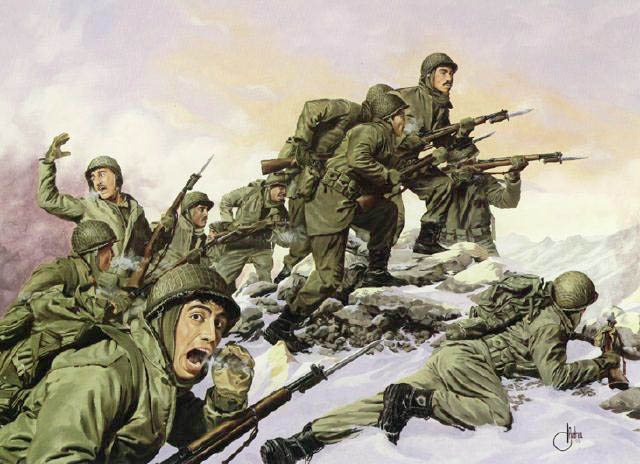
*artwork by Dominic D’Andrea depicting the U.S. 65th Infantry Regiment’s bayonet charge against a Chinese division during the Korean War
The poem is structured as three stanzas and has no clear nor defined rhyming pattern. Instead, it features heavy and emphasized use of enjambement. It seems to be that this lack of any rhyme seeks to parallel the lack of reason throughout the poem. It does not simply compliment but adds to and accentuates its meaty themes. It is usually the case that when reading a poem whose contents are weighty, unpredictable, frenetic and significant to comprehend, one usually seeks comfort in the predictable nature of a sturdy rhyming pattern. In this case, there is none, a unique and intelligent omission which adds to the unpredictable, distressing and overwhelming timbre of the poem. Bayonet Charge is a dynamic and striking poem that uses a number of high-powered and cogent techniques which serve to influence the reader in deep places.
Now to Kamikaze, which presents a reality of conflict very different from the one presented within Bayonet Charge. It tells the story of a kamikaze pilot who, after having embarked upon his suicide mission, looks out of the aircraft to see the land on which he grew up, an event which reminds him of his family and homeland. He decides to abandon his mission and return home. Upon returning, he is rejected by his family and those who once loved and cherished him who now see him as a coward, a man unwilling to sacrifice his life for his country. Repudiated by those he thought would embrace him, he lives a life of misery that is only lightened by the birth of a new generation, one which for a brief period is loving, before being conditioned toward spurning the protagonist.

*a kamikaze pilot securing a hachimaki onto his head
Whereas in Bayonet Charge, the protagonist frantically charges in the direction of death, Kamikaze’s protagonist shies away from it and sees a life beyond peril and glory. In this sense, both poems seek to represent the peculiarity of a particular belief that people hold. Specifically, that a man who charges into the jaws of death should be glorified and acclaimed for his great brave and holy actions. The tremendous awe-inspiring nationalistic impulse that all brave and right-minded soldiers have! It is an altogether strange ideology which dictates that all noble, virtuous and valiant soldiers in order to attain glory, must welcome and inadvertently seek inevitable death. It is one of many bizarre human attitudes or concepts that when examined in close detail lose any of the logical and sensical legitimacy that they may have once held within one’s mind. This idea is powerfully captured in one of the poem’s final lines with ‘King, honour, human dignity, etcetera/Dropped like luxuries in a yelling alarm’. What does a soldier care for a king when he is about to die?
Nevertheless, it an idea one that both poems scrutinize and find fault with in very different ways, detailing an individual’s instinct to shy away from a predetermined end. It is perhaps one of the strongest and most challenging human impulses to overcome. Instead of marvelling as a distraction, should we not be attempting to prevent situations in which such acts are necessary and required to overcome adversity?
Kamikaze is a poem that unlike ‘Bayonet Charge’ attributes 7 6-line stanzas which feature alliteration at the end of the first five. However, like Bayonet Charge, it does not include any obvious rhyming pattern with heavy use of enjambement, flowing both between stanza lines and the stanzas themselves.
In conclusion and similarities and differences aside, I think both poems evoke the contradictions of war and highlight the experiences of both cultures the poems reference. Detailing the expectations society has of men willing to fight and the scorning those who don’t receive, the two poems use commanding and dynamic language techniques to convey challenging themes. 12/2024
Copyright 2025 noaxlp.co.uk
 NLP
NLP 