Forms of the Shakespearean and Petrarchan sonnets and their relationship to Shelley’s chosen form in Ozymandias
What is a sonnet?
A sonnet is a form of poetry that is usually used to express one’s love for another.
Sonnets have lines grouped in different ways:
- Couplet – two lines
- Quatrain – four lines
- Sestet – six lines
- Octave – eight lines
Within the group of lines, they follow a rhyme scheme particular to the type of sonnet (in this case Shakespearean or Petrachan). This is represented by capital letters relating to a particular rhyme pattern.
Shakespearean sonnets
- End in two lines that rhyme with one another, called a couplet.
- Usually change the rhyming pattern every four lines – so that each sonnet is made up of three quatrains.
- A traditional Shakespearean sonnet has a rhyme scheme of ABAB CDCD EFEF GG, each letter refers a particular rhythm in the words.
Petrarchan sonnets
- All have 14 lines, usually split into two sections: an octave (A rhyming section of a poem with eight lines) followed by a sestet (A rhyming section of a poem with six lines).
- The octave usually introduces the reader to a problem or conflict and the sestet then provides the solution. The change that occurs between the octave and sestet is called a volta
- Tend to follow a rhyme scheme of ABBAABBA CDCDCD or ABBAABBA CDECDE
What is a volta?
Voltas can occur in both forms of sonnet.
The volta is a turn of thought or argument within a sonnet. In the case of the Petrarchan sonnet it occurs between the octave and the sestet. And before the final couplet in a Shakespearean sonnet.
Examples of argument transition voltas are but, yet, except and still.
Examples of time change voltas are then, next, or now.
Shelley’s Ozymandias:
In Percy Shelley’s poem Ozymandias, it is clear that the poem is greatly influenced by both the Petrarchan sonnet rhyme scheme and the Shakespearean sonnet rhyme scheme to amalgamate Ozymandias’ love for himself, his vanity.
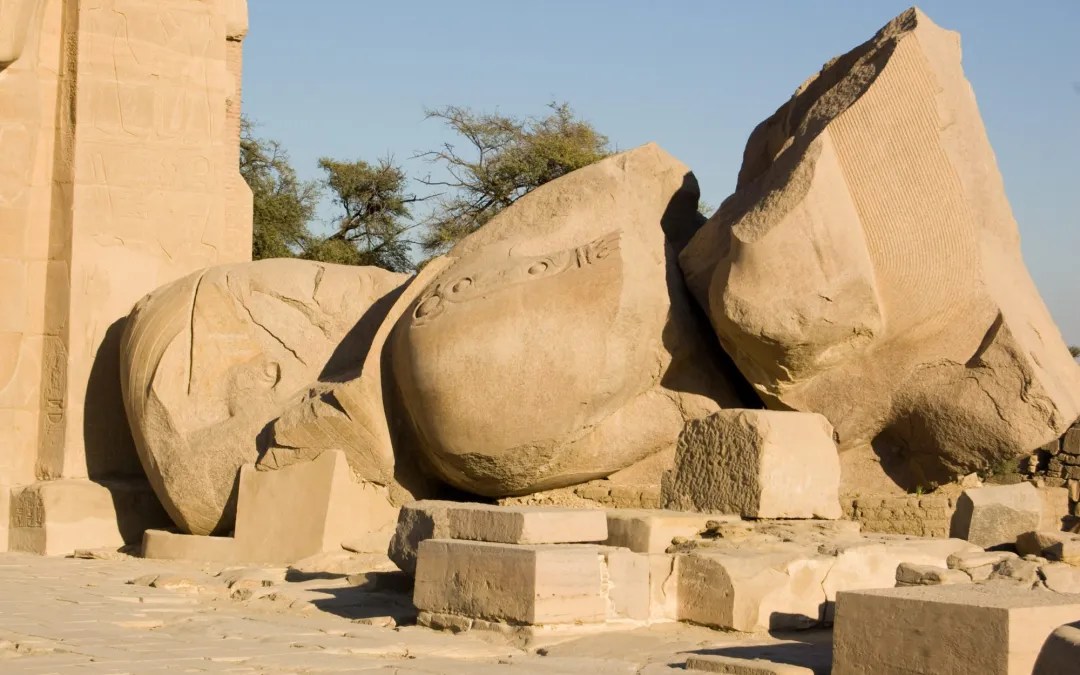
*the fallen statue of Ramesses II at the Ramesseum in Luxor, Egypt, 1279-1213 BC
It is likely that Shelley (1792 – 1822) was greatly influenced by the works of Shakespeare. (1564 – 1616) as his works by this time would have been widely recognised and respected.
The Petrarchan sonnet was originated in Italy by Giacomo da Lentini, a prominent and well-respected poet in the 13th century.
So, both sonnet forms in themselves are about love, an important theme in Ozymandias.
I think Shelley chose to incorporate both forms of sonnets because he respected them and wished to try something different. He wished to defy the standard rules of poetry and break with tradition, suggesting non-conformity and an anti – establishment position.
The rhyme scheme of Ozymandias follows ABAB-ACDC-EDE-FDF with less memorable rhymes (slant rhymes such as appear/despair). A fleeting rhyme that reflects the theme of fading with time. 15/03/24
Biographical information on Robert Browning and the influences that provoked him to write My Last Duchess
‘His poetic genius is most evident in his mastery of the dramatic monologue as a technique for powerful poetic narrative and rich psychological portraiture.’
William Browning was born in 1812 in Southeast London, into a family that valued education and intellectual exploration. His father, a clerk at the Bank of England, owned an extensive collection of books that encouraged Browning to delve into a broad spectrum of literature. As a result, his early reading included not only poetry but also history and educational texts, which profoundly influenced his writing and helped him develop a reputation for possessing an expansive knowledge base.
The poet who had the most significant impact on Browning during his formative years was Percy Bysshe Shelley. The ideals he encountered in Shelley’s work—such as atheism and vegetarianism—shaped both his lifestyle choices and philosophies. Browning’s admiration soon grew to encompass other great Romantic poets, including Keats and Byron, whose voices further enriched his own poetic expression.
Due to his family’s considerable wealth, Browning had the unique opportunity to pursue poetry without the immediate pressure of financial insecurity. This freedom allowed him to refine his craft without the constraint of needing to earn a living from it. Though his formal education was limited, his parents were intellectual powerhouses who instilled a wealth of knowledge in him. His father, well-versed in Greek and Latin, passed on his insights, while his mother, Sarah Anna Wiedemann, provided a spiritual and religious education, having been born in Scotland to German parents and being a devoted churchgoer.
However, Browning’s non-conformist beliefs barred him from studying or working at many prestigious English universities. His brief attendance at London University, combined with a few trips abroad, constituted the majority of his university experience, yet it was in this setting that he began publishing his first plays and longer poems. His debut work, Pauline: A Fragment of a Confession, is infused with the personal anxieties and passions of his youth, touching on the vulnerabilities he felt growing up in such a complex environment. Criticism of this work, particularly John Stuart Mill’s condemnation of the dramatic monologue’s “intense and morbid self-consciousness,” deeply affected Browning. It led him to resolve never to publish anything so intimately revealing again, committing instead to a more objective and impersonal approach to his writing.

*photograph of Robert Browning taken by Herbert Rose Barraud in 1888 AD
In the following years, Browning continued to build his reputation, with notable publications such as Paracelsus (1835) and Sordello (1840), the latter of which faced harsher scrutiny. Nevertheless, by this time, Browning had emerged as one of the leading poets of his era, producing several renowned poems, including the famous My Last Duchess.
The poem itself invites contemplation of the intense emotions and profound themes that likely fueled its creation. Browning’s personal life during this period was marked by significant connections that mirrored the poem’s narrative. In 1844, Elizabeth Barrett published ‘Poems‘, which featured praise for Browning’s work. Their correspondence soon blossomed into love, despite her frail health and tyrannical father, who isolated her and denied her essential medical care. Driven by love and defiance, Browning and Barrett married secretly and left for Pisa.
What stands out as particularly intriguing is the striking parallel between Browning’s life and the themes of My Last Duchess. The poem centers on a husband’s jealousy and paranoia regarding his wife’s fidelity—emotions that echo Browning’s own experiences with Barrett’s oppressive domestic conditions. Though these personal events unfolded after the poem’s 1842 publication, one must consider the possibility that Browning’s relationship with Barrett had begun earlier than is often assumed, suggesting a deep-seated tension in their correspondence.
The vividness with which Browning paints the Duke of Ferrara—the character that appears to evoke the controlling nature of Edward Barrett—is hauntingly powerful. It raises questions about the artistic inspiration rooted in the real-life dynamics between Browning and Barrett. Writers often draw from their histories and relationships to convey deep, resonant themes, and the intensity of feeling in My Last Duchess truly reflects the profound emotional landscape that Browning navigated in his life. The couple’s secretive marriage in 1846, after just a year together, further underscores the depth of their shared struggles and their fervent passion for one another, revealing the intricate weaving of personal experience and artistic expression in Browning’s work.
On how power and conflict is represented in London by William Blake when compared to The Charge of the Light Brigade by Alfred Lord Tennyson
When comparing these two poems, it is crucial to first explore the significant themes present in both works. A notable theme is the bloodshed associated with war and the soldier’s oftentimes ‘meaningless’ death. This theme is more prominent in Tennyson’s poem, yet it certainly resonates in Blake’s work. In the third stanza of London, for instance, we find the line, “the hapless soldier’s sigh runs in blood down palace walls,” which poignantly captures this sentiment. Both poems were crafted during periods when war and conflict weighed heavily on the minds of their authors. Blake, a fervent supporter of the French Revolution, sought to express a perspective akin to Tennyson’s: after enduring countless battles, a soldier may adopt a grim outlook on life, concluding that their suffering, along with that of their comrades, has ultimately been futile. Although the cause may have been noble, their deaths seem to yield no substantive change.
Tennyson’s The Charge of the Light Brigade underscores this theme throughout, while Blake’s London—though still addressing war’s impact—conveys a different yet equally profound message. During Blake’s time, the pressing issues of disease and destitution within impoverished communities starkly contrasted with a wealthy upper class indifferent to their plight, a situation largely of their own making. London vibrates with vivid descriptions and acute observations from a politically charged Blake, aiming to expose the stark reality facing those at the heart of Britain’s industrial transformation.
Moreover, both poems grapple with the dissonance between the glorification of war and its grim actualities. In The Charge of the Light Brigade, the imminent death of soldiers stems from the poor decision-making of their superiors. War, despite its portrayal as a noble endeavor, results in devastating loss, a notion Tennyson emphasizes through the sorrow and regret felt by observers witnessing the downfall of these soldiers. The poem invites reflection on how, had senior officials prioritized the lives of those they command, alternatives to preventable death could have been found. Instead, they justify the needless loss through glorification, honoring the courageous acts of those sent to perish. Similarly, in the final stanza of London, Blake challenges the reader to consider whether ‘sacred’ events like marriage should be tainted by societal degradation or instead filled with joy and celebration.

*Guernica by Pablo Picasso, 1937 AD
In essence, both poems advocate for urgent change and reform, expressing a vital call for those in power to value and protect the lives of individuals entrusted to their care, demonstrating love and compassion. They assert that there comes a time when it is imperative to transcend seemingly obvious impulses and do what is right for those deserving of life.
Analysis of War Photographer by Carol Ann Duffy
In War Photographer, the poem presents a nuanced yet striking portrayal of the experiences of individuals tasked with documenting the harrowing tragedies of human history and the toll such experiences take on their psyche. The central purpose appears to acknowledge the often-overlooked professionals, such as medics and journalists, particularly war photographers, who play critical roles during wartime—not receiving the same recognition as soldiers. The poem, published in 1985, emerges a decade after the Vietnam War, reflecting on a period rife with conflict. During this time, visual documentation, such as photography and video, surfaced within global media, yet the stories of those capturing these stark realities often slipped from public consciousness.
The first stanza of the poem employs vivid imagery, establishing an emotionally charged atmosphere. The protagonist finds themselves ‘finally alone’ in a dark room processing photographs, which are described as ‘spools of suffering’ arranged in ‘ordered rows.’ The word ‘ordered’ serves to contrast the systematic nature of the photographs with the chaotic, tumultuous essence of war. A sense of gloom envelops the reader, accentuated by the dim red light surrounding the protagonist—suggestive of blood and hinting at morally compromised behavior. A comparison is drawn between the protagonist and a priest ‘preparing to intone a mass,’ leading into the culmination of the stanza as ‘All flesh is grass.’ This powerful phrase underscores the pervasive death encountered by photographers in war-torn areas.
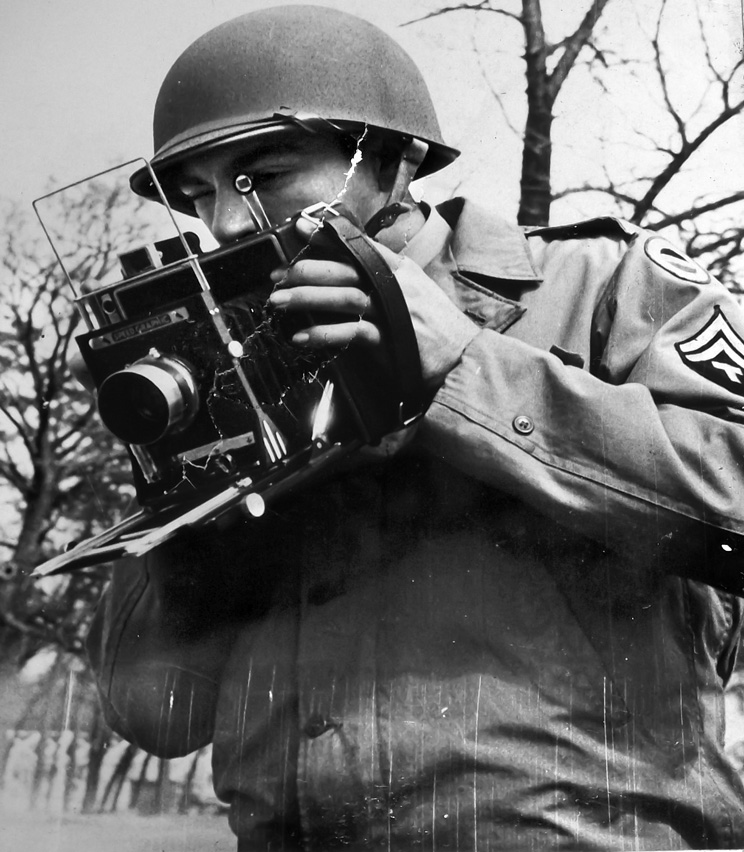
*Corporal Kenneth Elk, a photographer with the U.S. Army’s 163rd Signal Corps Photo Company during WWII
The meticulous rhyme scheme introduced here reverberates throughout the poem, establishing a sense of weight and prominence. Though many poems exhibit rhyme, the use of enjambment within the poem’s rigid structure is particularly striking. One of its most compelling features is the unwavering form, allowing the emotionally charged flow to endure without faltering. This meticulous construction reflects the poet’s mastery, achieving a rare equilibrium often elusive in poetry. This balance contributes to the poem’s potent yet succinct emotional weight and stylistic resonance.
In conclusion, War Photographer stands as a remarkable work, provoking thought through its emotional impact. The poem’s carefully structured rhyme scheme enhances its profound meaning, creating a crescendo of feeling. Regrettably, its relevance continues to intensify, serving as a stark reminder that, as Aldous Huxley eloquently observed, “men do not learn very much from the lessons of history,” a lesson that remains crucial for us to remember.
22/10/24
Copyright 2025 noaxlp.co.uk
 NLP
NLP 